

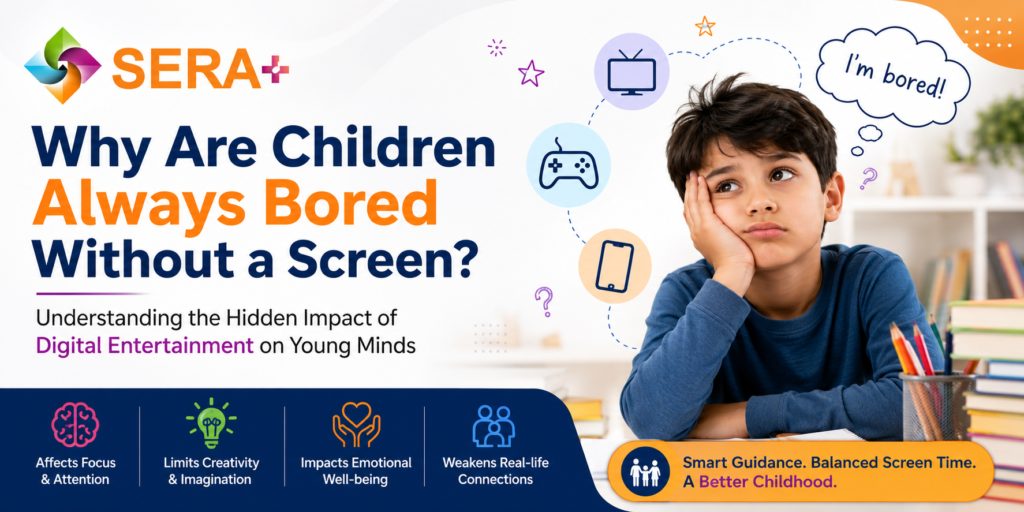
Have you ever noticed that the moment a television is switched off or a mobile phone is taken away, many children immediately say, “I’m bored!” This has become one of the most common concerns among modern parents. A child can have shelves full of toys, books, puzzles, colouring materials, bicycles, and outdoor space, yet still feel there is “nothing to do.” This raises an important question: Why are children always bored without a screen?
The answer is more complex than simply blaming technology. Today’s children are growing up in a world where screen time for children has become a normal part of everyday life. Smartphones, tablets, televisions, gaming consoles, and streaming platforms provide constant entertainment with little effort. Bright colours, fast-moving videos, instant rewards, and endless scrolling keep young minds continuously stimulated.
Over time, the brain begins to expect this constant stimulation. Activities that require patience, creativity, or imagination, such as reading a book, drawing, solving puzzles, building with blocks, or simply sitting quietly, can suddenly seem slow and uninteresting. This doesn’t mean children are becoming lazy or less intelligent. Instead, it reflects how the brain adapts to repeated patterns of digital stimulation.
Understanding the effects of screen time on children is becoming increasingly important for parents, teachers, and schools. Childhood is the period when the brain develops essential skills such as attention, emotional regulation, creativity, communication, and problem-solving. These abilities grow through real-life experiences, not just digital entertainment.
The encouraging news is that boredom itself is not the enemy. In fact, psychologists often describe boredom as the beginning of creativity. When children are not constantly entertained, their brains naturally start to search for new ideas, invent games, explore their surroundings, and engage in imaginative play. This is why experts encourage families to include regular screen-free activities for children in their daily routine.
Modern technology is not inherently harmful. Educational platforms, online learning, coding games, documentaries, and interactive learning apps can all contribute positively to a child’s development when used wisely. The challenge lies in maintaining balance. Parents who practise digital parenting understand that technology should complement childhood, not replace it.
Throughout this guide, we’ll explore why children become bored without screens, how digital entertainment affects the developing brain, what science says about healthy screen habits, and practical strategies for helping children rediscover creativity, curiosity, and independent play.
How Digital Entertainment Changes a Child’s Brain
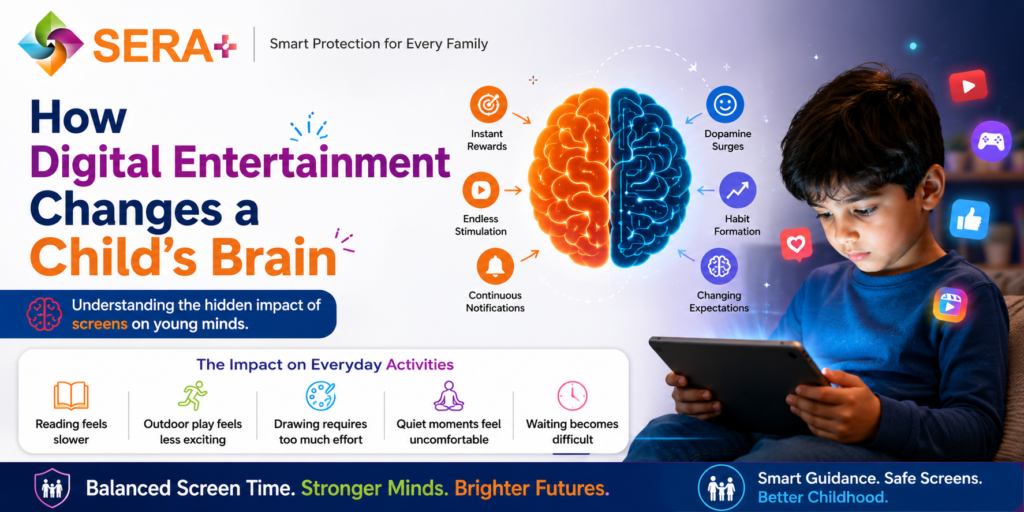
The human brain is naturally designed to seek rewards. Every enjoyable experience playing with friends, learning something new, achieving a goal, or receiving praise releases dopamine, a neurotransmitter associated with motivation and pleasure. Digital devices have learned to capture this reward system extremely efficiently.
Every swipe on a social media app, every new YouTube video, every game level, every notification, and every colourful animation provides another small reward. Unlike traditional play, where children must create their own fun, digital platforms continuously provide new stimulation without requiring much imagination.
This constant stimulation gradually changes expectations. Children begin to expect entertainment to arrive instantly rather than creating it themselves.
As a result:
- Reading feels slower.
- Outdoor play feels less exciting.
- Drawing requires too much effort.
- Quiet moments feel uncomfortable.
- Waiting becomes difficult.
This explains why many parents observe that children become restless almost immediately after putting away a screen.
Research in child psychology suggests that excessive screen time for children may shorten attention spans, reduce frustration tolerance, and decrease opportunities for independent creative thinking. While screens themselves are not the sole cause, replacing many real-world experiences with passive digital consumption can significantly affect development.
Children who spend hours watching fast-paced videos may struggle to enjoy activities that build patience, such as building models, painting, gardening, practising music, or reading chapter books. This doesn’t happen overnight. It develops gradually through repeated habits. Fortunately, the brain is highly adaptable. By encouraging healthy screen habits and providing meaningful alternatives, parents can help children regain their natural curiosity and love for learning.
Why Boredom Is Good for Children and How Screens Affect the Developing Brain
One of the biggest misconceptions in modern parenting is that boredom is a problem that must be solved immediately. The moment children complain that they have nothing to do, many adults instinctively hand them a smartphone, tablet, or television remote. While this may temporarily stop the complaints, it also removes an important opportunity for growth. In reality, the benefits of boredom for children are backed by psychology and neuroscience. Boredom is not a sign that something is wrong; it is often the first step toward creativity, independence, and lifelong learning.
When children experience boredom, their brains naturally begin searching for ways to stay engaged. They might start building with blocks, creating stories with toys, drawing pictures, inventing games, or exploring the outdoors. These activities may seem ordinary, but they play a powerful role in child development and screen time balance. Every time children create their own entertainment, they strengthen problem-solving skills, imagination, decision-making, and confidence.
Unfortunately, excessive screen time for children interrupts this natural process. Digital devices provide instant entertainment before a child’s imagination has a chance to activate. Instead of asking, “What can I create?” children begin asking, “What can I watch?” Over time, this habit can reduce curiosity and make independent play feel less rewarding.
The Science Behind Dopamine and Digital Entertainment
To understand why screens are so attractive, it helps to understand dopamine.
Dopamine is often called the brain’s “feel-good” chemical, but its real role is motivation. Whenever we achieve something enjoyable, such as finishing a puzzle, scoring a goal, learning a new skill, or receiving praise, the brain releases dopamine. This encourages us to repeat positive behaviours. Digital entertainment has become exceptionally good at stimulating this reward system.
Every new video recommendation, game reward, social media notification, colourful animation, and scrolling feed creates tiny dopamine boosts. These rewards happen so frequently that the brain begins expecting constant stimulation.
This is why many children quickly lose interest in slower activities such as:
- Reading books
- Drawing pictures
- Playing board games
- Gardening
- Building LEGO models
- Completing puzzles
- Writing stories
These activities still produce dopamine, but only after effort and patience. Compared to fast-moving digital content, they may initially seem less exciting. This doesn’t mean screens are “addictive” in every case. Rather, frequent exposure to highly stimulating digital content can make everyday experiences feel less rewarding. Parents who understand how to reduce screen addiction in kids recognise that the solution isn’t eliminating technology. Instead, it’s about helping children experience satisfaction from both digital and real-world activities.
Why Children Say, “I’m Bored” So Quickly
Many parents are surprised by how fast boredom appears after screens are removed. A child may spend two hours watching videos and then, within five minutes of turning off the television, complain about having nothing to do.
Why? Because digital entertainment requires almost no effort.
- Television provides stories.
- Games provide challenges.
- Videos provide humour.
- Apps provide endless novelty.
- The child’s brain simply receives.
- Real-world play is different.
- Children must imagine.
- They must invent.
- They must experiment.
- They must sometimes fail before discovering something enjoyable.
- This small period of discomfort is actually where learning begins.
Psychologists often describe boredom as the “gateway to creativity.” Once children move past the initial feeling of having nothing to do, they frequently invent games, build imaginary worlds, create artwork, write stories, or begin exploring nature. Parents who immediately solve boredom with a screen unintentionally interrupt this creative process. Allowing children time to work through boredom teaches resilience, patience, and independence. These are qualities that support academic success, emotional wellbeing, and lifelong learning.
The Hidden Effects of Excessive Screen Time on Children
Most discussions about the effects of screen time on children focus on physical health, such as eye strain, poor posture, or reduced physical activity. While these concerns are important, the emotional and cognitive effects deserve equal attention.
Children who spend excessive time on digital devices may experience:
- Shorter attention spans
- Difficulty concentrating on slower tasks
- Reduced frustration tolerance
- Less imaginative play
- Increased dependence on external entertainment
- Reduced face-to-face social interaction
- Lower interest in books and creative hobbies
These effects don’t happen because technology is inherently bad. Instead, they occur when digital entertainment replaces experiences that help children develop emotional resilience, creativity, and communication skills.
Healthy childhood development depends on variety.
Children need opportunities to:
- Read stories.
- Build friendships.
- Explore nature.
- Solve real-life problems.
- Participate in sports.
- Create art.
- Listen to music.
- Help with household tasks.
- Ask questions.
- Make mistakes.
- Learn independently.
These experiences strengthen the brain in ways that passive entertainment simply cannot.
Why Imagination Matters More Than Ever
Imagination is often underestimated because it looks like simple play.
A child pretending to be an astronaut, teacher, doctor, chef, or explorer may appear to be “just playing,” but their brain is performing remarkably complex work.
Imaginative play develops:
- Language skills
- Emotional intelligence
- Creativity
- Empathy
- Memory
- Planning
- Flexible thinking
- Problem-solving abilities
This is why educators strongly encourage creative activities without screens during early childhood. When children invent stories or role-play everyday situations, they practise understanding different perspectives, organising ideas, and solving imaginary challenges. These skills later support reading comprehension, writing ability, teamwork, and leadership. Unfortunately, constant digital entertainment can reduce opportunities for this kind of creative thinking.
If every story comes from YouTube, every adventure comes from a video game, and every answer comes from Google, children have fewer chances to invent their own ideas. Encouraging screen-free activities for children helps restore this balance. Something as simple as cardboard boxes, art supplies, building blocks, or a walk through a park can inspire hours of imaginative exploration.
Parents Play the Biggest Role
Children learn by watching adults. If parents spend every free moment looking at their phones, children naturally assume that screens are the primary source of entertainment. This is why digital parenting is about modelling behaviour, not just setting rules.
Families who create healthy digital habits often:
- Eat meals without phones.
- Read together before bedtime.
- Spend weekends outdoors.
- Play board games as a family.
- Encourage conversation instead of scrolling.
- Set consistent limits on recreational screen use.
- Celebrate creativity instead of constant consumption.
Children are far more likely to develop healthy screen habits when they see those habits practised consistently at home. The goal isn’t perfection. The goal is balance. Technology should enrich childhood, not replace the curiosity, creativity, friendships, and adventures that define it.
Practical Ways to Reduce Screen Dependency and Help Children Rediscover Creativity
By now, it is clear that technology itself is not the problem. Smartphones, tablets, educational apps, and computers are valuable tools when used with purpose. The real challenge begins when screen time for children becomes the primary source of entertainment, replacing reading, outdoor play, family conversations, hobbies, and creative exploration. The good news is that parents do not need to remove screens completely to create healthier habits. Small, consistent changes can make a remarkable difference in a child’s emotional, social, and intellectual development.
One of the most effective ways to reduce dependence on screens is by changing the family routine instead of simply introducing strict rules. Children respond much better to positive alternatives than to constant restrictions. If a parent says, “Put your phone away,” without offering another engaging activity, the child naturally feels frustrated. However, if that same parent suggests baking cookies together, building a fort with blankets, visiting a nearby park, or reading an exciting story, the child begins to see that entertainment exists beyond digital devices.
This is one of the most important principles of digital parenting. The goal is not to eliminate technology but to ensure it supports learning instead of replacing childhood experiences.
How Parents Can Reduce Screen Dependency Without Daily Arguments
Many parents worry that limiting screen time will lead to tantrums, complaints, or endless negotiations. While some resistance is normal, children gradually adapt when expectations remain consistent. The key is to introduce changes slowly rather than making drastic overnight decisions.
For example, if a child currently spends four hours each day on recreational screens, reducing that time by thirty minutes each week is often more successful than banning devices completely. During the extra free time, parents can introduce screen-free activities for children that feel enjoyable rather than compulsory.
Creating predictable routines also helps children know what to expect. When children understand that homework is followed by outdoor play, family dinner, reading time, and then limited screen use, they become less likely to argue because the routine feels fair and familiar.
Another helpful strategy is creating device-free zones within the home. Bedrooms, dining tables, and family gatherings should encourage conversation instead of scrolling. Eating meals together without phones allows children to develop communication skills, learn social etiquette, and strengthen family relationships.
Equally important is the behaviour of adults. Children observe far more than they listen. Parents who spend every spare moment checking emails or social media unintentionally teach that screens are the centre of daily life. Demonstrating healthy screen habits by putting phones away during conversations sends a much stronger message than simply asking children to do so.
The Best Screen-Free Activities for Different Age Groups
Children do not stop needing entertainment when screens are reduced—they simply need opportunities to discover different kinds of fun. Choosing activities that match a child’s age and interests makes the transition much smoother.
For toddlers and preschoolers, imaginative play remains one of the most valuable learning experiences. Building blocks, pretend kitchens, puzzles, colouring books, clay modelling, singing songs, dancing, and storytelling all strengthen language development, creativity, and fine motor skills. Even simple household activities like sorting laundry by colour or watering plants can become exciting learning experiences.
Primary school children often enjoy activities that combine creativity with movement. Cycling, skipping rope, treasure hunts, gardening, painting, science experiments, cooking simple recipes, and building models encourage curiosity while developing practical life skills. Reading adventure books together also introduces children to exciting worlds that stimulate imagination far beyond what passive videos can provide.
Older children and teenagers benefit from hobbies that challenge their growing independence. Photography, creative writing, robotics, coding projects, sports, music lessons, volunteering, chess, debate clubs, and entrepreneurship activities help them discover personal interests while reducing reliance on digital entertainment. These experiences build confidence, resilience, and problem-solving abilities that remain valuable throughout adulthood.
The objective is not simply to replace one activity with another. It is helping children realise that enjoyment, achievement, and relaxation can all exist beyond a screen.
The Powerful Role of Reading in Rebuilding Attention
One of the biggest concerns surrounding excessive screen time for children is its effect on attention span. Fast-moving digital content trains the brain to expect constant change, making slower activities feel challenging. Reading offers an effective solution.
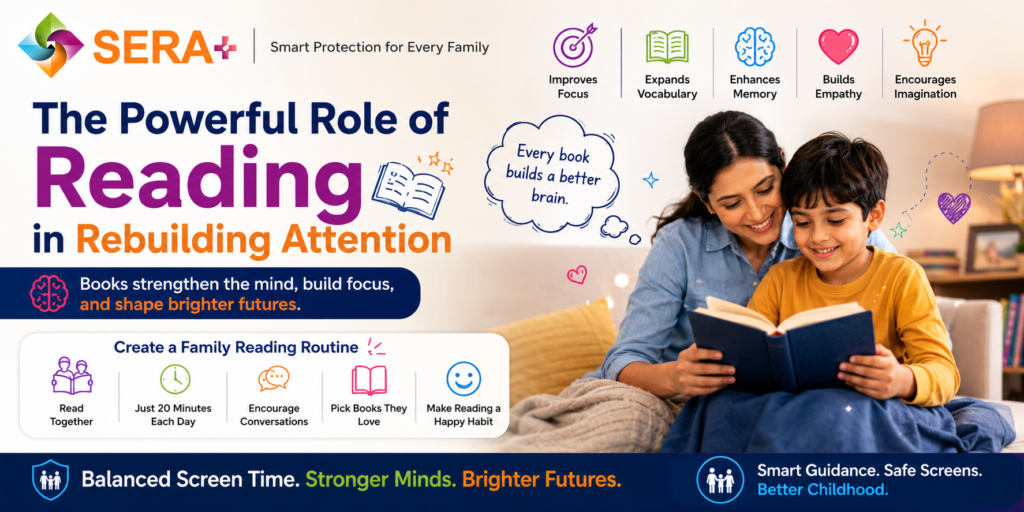
Books encourage children to slow down, imagine characters, visualise settings, and think critically about stories. Unlike videos, books require active participation. Every chapter strengthens concentration, vocabulary, comprehension, memory, and emotional understanding.
Parents often worry that children dislike reading, but in many cases, they simply have not found books that match their interests. Adventure stories, mystery novels, comics, science books, biographies, and fantasy series can all inspire a lifelong love of reading when introduced at the right time.
Creating a family reading routine is particularly effective. When parents read alongside their children instead of asking them to read alone, books become associated with comfort, curiosity, and quality family time. Even twenty minutes of shared reading each evening can gradually rebuild attention span while encouraging meaningful conversations.
Reading also strengthens many of the same cognitive skills that excessive digital entertainment can weaken. It develops patience, imagination, empathy, and sustained focus, all essential for academic achievement and lifelong learning.
How Schools Can Encourage Healthy Digital Habits
Parents cannot solve the challenge of excessive screen use alone. Schools play an equally important role in helping children develop balanced relationships with technology.
Modern education increasingly relies on digital learning platforms, online assessments, and educational videos. These tools offer tremendous advantages when used thoughtfully. However, they should complement, not replace, hands-on learning experiences.
Schools can promote healthy screen habits by balancing technology with activities such as classroom discussions, science experiments, group projects, outdoor learning, library visits, music, drama, sports, and creative arts. These experiences encourage collaboration, communication, leadership, and independent thinking.
Teachers also have an opportunity to educate students about responsible digital citizenship. Children should understand not only how to use technology but also when to disconnect. Lessons about online safety, responsible social media use, time management, and digital wellbeing prepare students for an increasingly connected world.
Parents and teachers achieve the best outcomes when they work together. Consistent expectations at home and school create an environment where children understand that technology is a valuable learning tool—not a replacement for real-life experiences.
How SeraPlus Supports Balanced Learning
Creating a healthy relationship with technology does not mean rejecting digital innovation. Instead, it means choosing platforms that encourage meaningful learning rather than passive consumption.
This is where SeraPlus plays an important role. Designed to support modern education, SeraPlus helps schools, teachers, parents, and students create organised, engaging, and purposeful learning experiences. Instead of encouraging endless scrolling or entertainment-driven screen use, the platform focuses on academic growth, communication, structured learning, and student development.
By integrating educational technology with thoughtful teaching practices, SeraPlus demonstrates that screens can become powerful learning tools when used intentionally. Students remain connected to their educational goals while still having time to read, play, explore nature, develop hobbies, and build meaningful relationships beyond the digital world.
A balanced childhood is not about choosing between technology and traditional learning; it is about ensuring both work together to support the child’s overall development.
As families embrace digital parenting, encourage screen-free activities for children, and establish healthy screen habits, children begin to rediscover something they were naturally born with: curiosity. They learn that the most memorable adventures often happen outside a screen, where imagination has no limits and every day offers a new opportunity to learn, create, and grow.
Building a Healthy Digital Future for Children
As technology continues to evolve, one truth remains constant: children need far more than digital entertainment to thrive. They need meaningful conversations, imaginative play, physical activity, books that spark curiosity, supportive relationships, and opportunities to explore the world around them. While smartphones, tablets, and computers have become valuable learning tools, they should never replace the real-life experiences that shape a child’s character and development.
The question, therefore, is not whether children should use technology. Instead, parents and educators should ask, “How can we help children use technology wisely while protecting their creativity, attention span, and emotional well-being?”
The answer lies in balance. Children who develop healthy screen habits are more likely to enjoy learning, communicate confidently, solve problems independently, and build stronger relationships. They learn that screens are tools—not the centre of their lives.
Simple Daily Habits That Make a Big Difference
Developing healthy routines doesn’t require expensive resources or dramatic lifestyle changes. Small daily habits often create the greatest long-term impact.
Families can encourage healthier behaviour by:
- Starting the day without immediately checking phones or tablets.
- Eating meals together without digital devices.
- Setting aside dedicated family reading time every evening.
- Encouraging outdoor games after school.
- Planning screen-free weekends whenever possible.
- Allowing children to experience boredom instead of instantly solving it with entertainment.
- Celebrating creativity through drawing, music, storytelling, cooking, gardening, and science experiments.
- Limiting recreational screen use before bedtime to improve sleep quality.
- Becoming positive role models by reducing unnecessary phone use themselves.
These habits gradually become part of everyday family life and help children understand that enjoyment comes from experiences—not only from screens.
Helping Children Build Lifelong Skills
Every screen-free moment gives children the chance to develop skills that will benefit them throughout life. Reading strengthens vocabulary and concentration. Outdoor play improves physical health and confidence. Creative hobbies encourage innovation and imagination. Family conversations build emotional intelligence. Sports teach teamwork and resilience. Music develops patience and discipline. Problem-solving activities improve critical thinking. When these experiences become part of everyday childhood, children naturally become more independent, confident, and curious learners.
This is why experts continue to emphasise the importance of maintaining a healthy balance between technology and traditional childhood experiences.
How SeraPlus Supports Meaningful Digital Learning
Technology becomes truly valuable when it serves education instead of replacing it. SeraPlus is designed with this philosophy in mind. Rather than encouraging endless passive screen use, SeraPlus helps schools, teachers, parents, and students create structured, engaging, and purposeful learning environments. The platform simplifies communication, supports academic progress, and encourages meaningful educational engagement while allowing children to maintain a healthy balance between digital learning and real-world experiences. By combining modern educational technology with responsible teaching practices, SeraPlus empowers schools to nurture learners who are not only digitally skilled but also creative, thoughtful, collaborative, and emotionally resilient. The goal is not to raise children who simply know how to use technology. The goal is to raise children who know when to use technology—and when to step away from it. The phrase “I’m bored” should not always be seen as a problem. More often, it is an invitation.
- It invites children to imagine.
- It invites them to create.
- It invites them to explore.
- It invites them to think independently.
When parents resist the temptation to solve every moment of boredom with a screen, children gradually discover something remarkable: their own imagination. A balanced childhood is one where technology supports learning without replacing curiosity, friendships, books, outdoor adventures, creativity, and meaningful family connections. By encouraging screen-free activities for children, practising digital parenting, reducing excessive screen time for children, and building healthy screen habits, families can help children grow into confident, capable, and lifelong learners. The future belongs not only to children who understand technology but also to those who know how to think creatively beyond it. And that is a gift that lasts a lifetime.